
Pre-trial claim
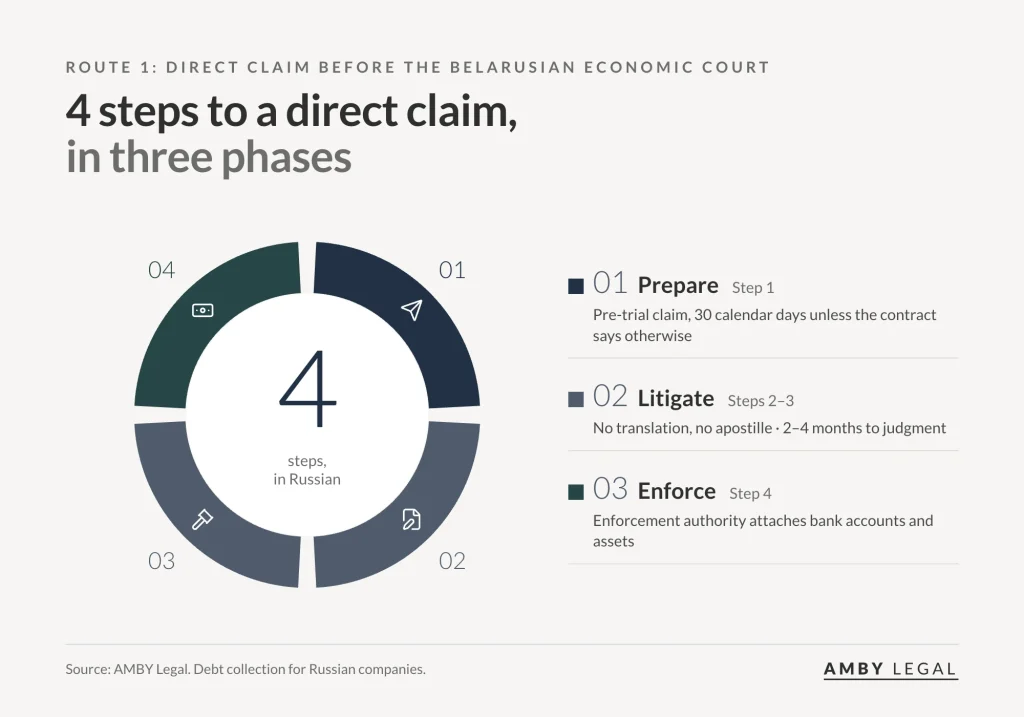
We draft and send the mandatory pre-trial claim to the Belarusian debtor – in Russian, legally precise and positioned for subsequent proceedings.

Debt Recovery from Belarusian Companies for Russian Companies
Russia and Belarus are the closest trading partners in the post-Soviet space. Billions of dollars of goods and services move between the two countries every year. And where there is trade, there are payment disputes. A Russian company whose Belarusian counterparty has not paid faces a specific set of options – and some significant advantages compared to creditors from most other countries.
The Belarus-Russia legal framework – built on the Minsk Convention, the Union State treaty and a range of bilateral agreements – gives Russian companies easier access to Belarusian courts and faster enforcement of Russian judgments in Belarus than almost any other foreign creditor enjoys. Russian commercial court judgments are enforced in Belarus without a separate recognition procedure. Russian documents do not require apostille. Proceedings before Belarusian economic courts are accessible to Russian companies directly.
AMBY Legal represents Russian companies and individual entrepreneurs in debt recovery proceedings against Belarusian debtors – from the initial pre-trial claim through to enforcement.
No apostille on documents: Under the 1993 Minsk Convention on Legal Assistance and Legal Relations in Civil, Family and Criminal Matters, documents issued by Russian state authorities are recognised in Belarus without apostille. A Russian company’s registration documents – extracts from the Russian Unified State Register of Legal Entities, certificates, court documents – are accepted in Belarusian proceedings without legalisation. This significantly simplifies the document preparation process compared to creditors from most other countries.
Direct filing in Belarusian courts: A Russian company can file a claim directly before the Belarusian economic court without first obtaining a Russian judgment. This is often faster than obtaining a Russian judgment and then seeking recognition in Belarus. The Belarusian economic court has jurisdiction over commercial disputes involving foreign companies – and Russian companies are among the most frequent foreign claimants.
Enforcement of Russian commercial court judgments without recognition: This is the most significant advantage. A final judgment of a Russian commercial court can be submitted directly to the Belarusian enforcement authority for execution without requiring a separate recognition procedure before a Belarusian court. This is faster and cheaper than the recognition procedure required for judgments from most other countries. The enforcement authority opens an enforcement case and proceeds to collect from the debtor’s assets.
Professional legal help in the field of debts collection in Belarus.
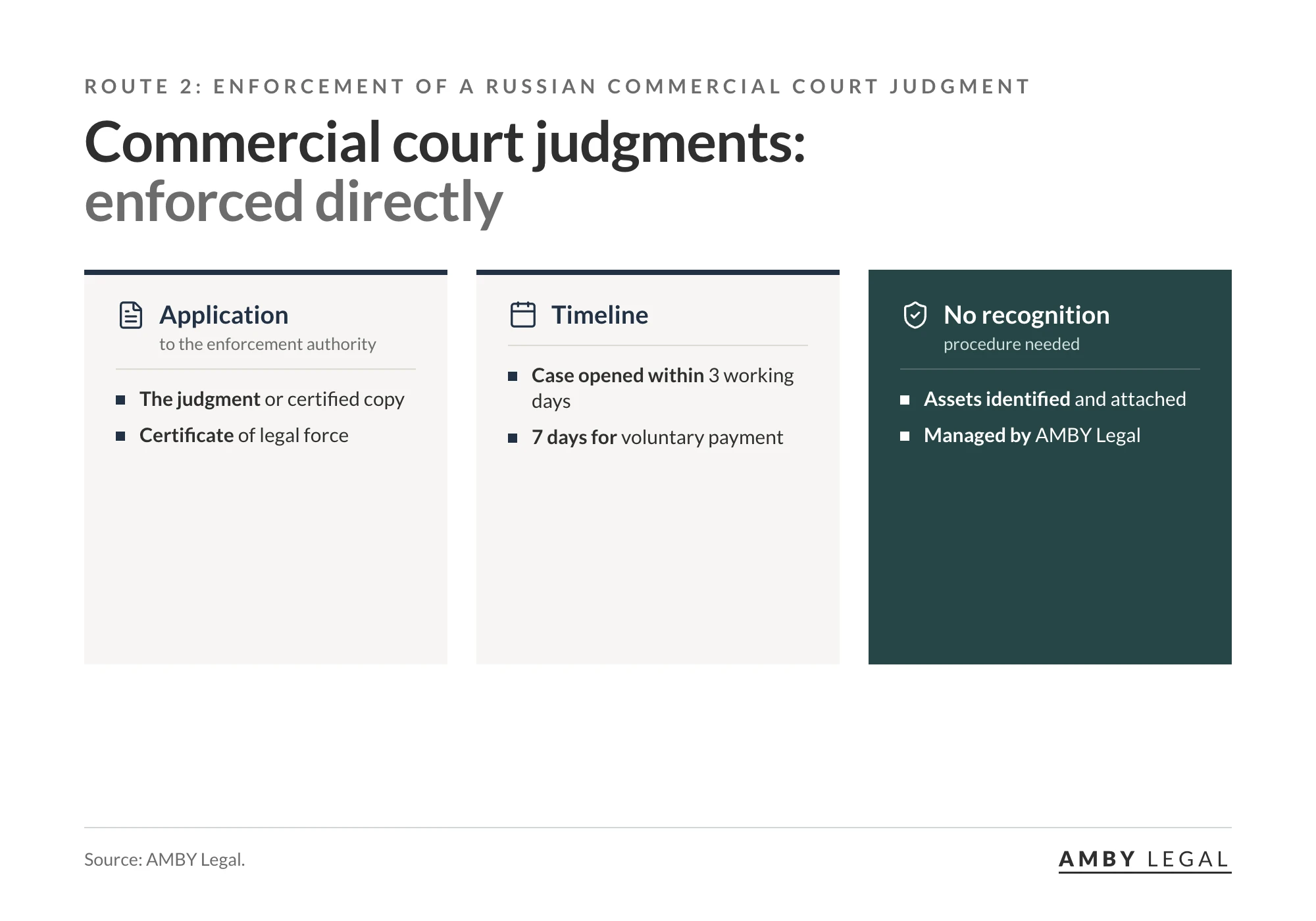
If a Russian company already has a final judgment of a Russian commercial court against the Belarusian debtor, it can be enforced in Belarus directly – without a recognition procedure before a Belarusian court. This is one of the most efficient cross-border enforcement routes available anywhere in the post-Soviet space.
The procedure is as follows. The Russian creditor submits an application to the enforcement authority at the location of the Belarusian debtor. The application must include the original or certified copy of the Russian commercial court judgment; a certificate from the Russian commercial court confirming that the judgment has entered into legal force; and documents identifying the debtor and the creditor.
The enforcement authority opens an enforcement case within three working days of receiving a complete application. The debtor is given seven days for voluntary compliance. If the debtor does not pay voluntarily, the enforcement officer proceeds to identify and attach the debtor’s assets – bank accounts, real estate, vehicles and other property.
We submit enforcement applications on behalf of Russian companies and manage the enforcement process through to receipt of payment.
No. Under the 1993 Minsk Convention, documents issued by Russian state authorities – including Russian state register extracts and court certificates – are recognised in Belarusian proceedings without apostille. This is one of the key practical advantages for Russian companies compared to creditors from most other countries.
Yes. A Russian company can file a direct claim before the Belarusian economic court without prior Russian proceedings. This is often faster than obtaining a Russian judgment and then enforcing it in Belarus.
Yes – a final Russian commercial court judgment can be submitted directly to the Belarusian enforcement authority without a separate recognition hearing before a Belarusian court. The enforcement authority opens the case and proceeds to collect within days of receiving a complete application.
Three years from the date the claim arose – typically the date payment was due. For enforcement of Russian court judgments, the application must be submitted within three years of the judgment entering into legal force. We advise on the limitation position at the outset.
For a direct claim in the Belarusian economic court – two to four months from filing to judgment, plus enforcement time. For enforcement of an existing Russian commercial court judgment – enforcement proceedings open within three working days of a complete application, with voluntary compliance expected within seven days and forced enforcement proceeding thereafter. Total time to payment depends on the debtor’s assets and cooperation.

Heirs and their advisers compare wills, statutory shares and notary timelines. The damage in a Belarusian company usually happens somewhere else: on the decision calendar that keeps running while the estate is being opened. This article compares the two clocks that govern the same company – the estate clock and the company clock – and […]

Your agreement is valid where you signed it. That says nothing about whether a Belarusian court will apply it. A Belarusian judge answers three separate questions – whether the marriage or divorce is recognised, whether the agreement’s form is accepted, and whether its terms survive Belarusian family law – and the answer to each depends […]

Say the owners of a company decide the general director has to go. Before the paperwork is done, they find out he has signed a supply contract, changed the bank mandate and got a resolution passed at a meeting that, in their view, was never properly called. Many owners assume that removing him will fix […]