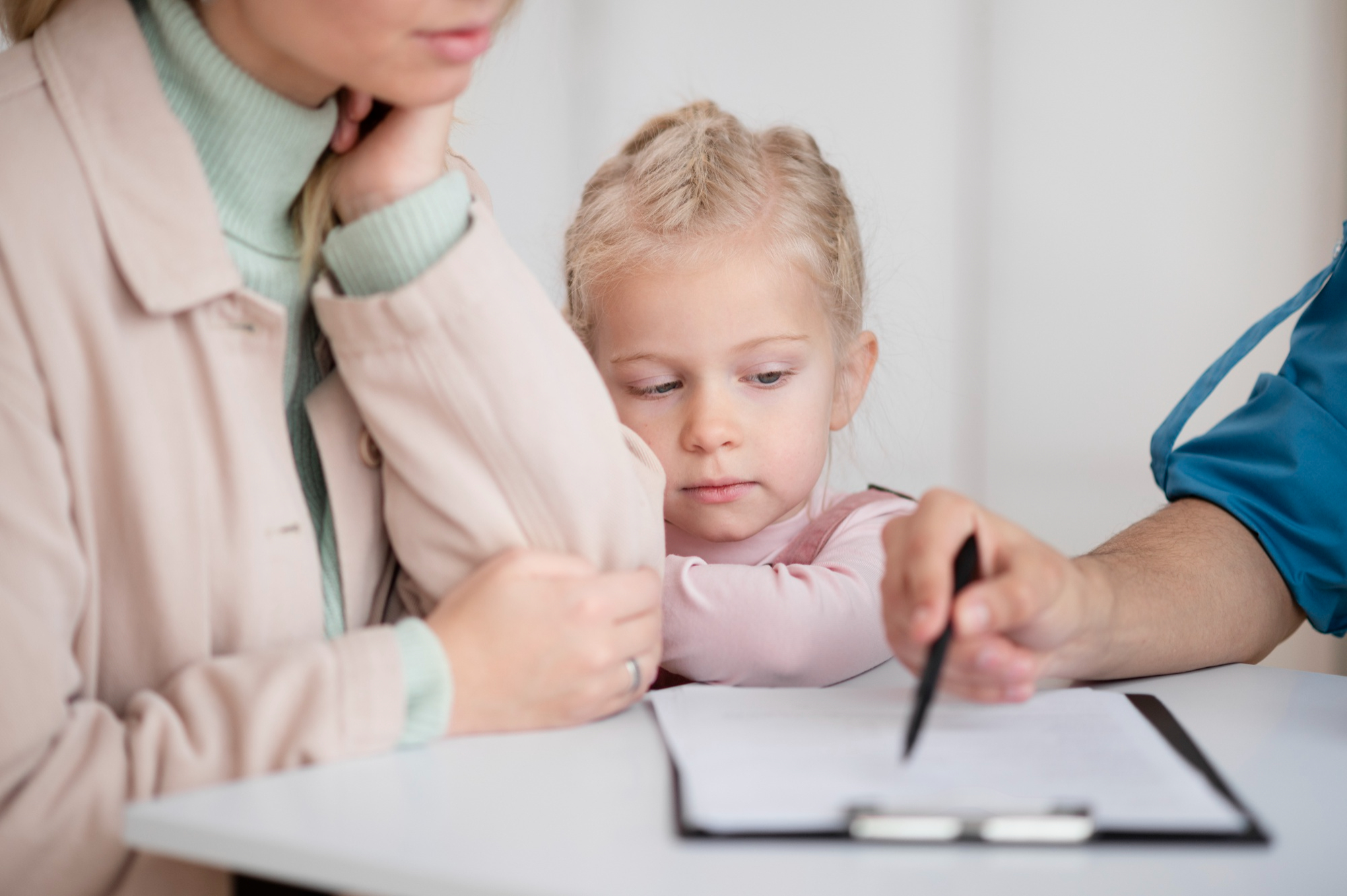
When a marriage ends, one parent often wants the child to carry the same surname they now use — usually a maiden name restored after the split, or the surname of a new spouse. It can feel like a small administrative step. Under Belarusian law it is neither automatic nor the custodial parent’s decision alone.
The matter is governed by the Marriage and Family Code, within which three articles are decisive. Article 69 establishes the basis on which a surname is assigned at birth; Article 70 prescribes when and how it may be altered; and Article 71 governs given names and patronymics. This guide sets out what these provisions mean in practical terms as of 2026, where the decision-making power resides, and how the other parent’s position bears on the outcome.
Divorce alone does not change your child’s surname
Start with the clearest rule in the Code: ending a marriage — or having it declared invalid — does not change a child’s surname. The same is true when the parent the child lives with remarries and takes a new surname. The child keeps the surname entered in the birth record until it is changed through the proper procedure.
That surname was fixed at birth registration under Article 69. Where the parents share a surname, the child takes it; where they differ, the child takes the mother’s or the father’s by agreement, and if the parents cannot agree, the guardianship authority decides. Whatever was recorded then stays recorded — a divorce changes the parents’ marital status, not the child’s name.
It also helps to separate two things people often merge. Restoring your own pre-marriage surname after divorce is your decision alone: a spouse who took a new surname on marriage may keep it or have the pre-marriage one restored. Changing the child’s surname is a different matter — it is not a by-product of restoring your own name, and it runs through the separate, discretionary process described below. Reverting to your maiden name does not carry the child’s surname along with it.
So the surname never changes automatically. The real question is how to change it — and that is where Article 70 comes in.
Two routes to a new surname
Article 70 offers two distinct paths, and which one applies depends on what you are asking for.
Both parents agree. If the mother and father jointly ask to change the surname of a child under sixteen to the other parent’s surname, the guardianship authority may permit it — provided the change serves the child’s interests. This is the smoothest route: a joint application removes the main source of conflict, and the authority’s role is mainly to confirm the change benefits the child rather than merely suiting the parents.
One parent applies. More often, only the parent the child lives with wants the change — typically to give the child their own restored or new surname. Here too the authority may allow it “based on the interests of the child,” but the analysis is more searching, because the other parent has not consented and their view has to be weighed. This is where most disputes arise, and where preparation matters most.
Notice what both routes share: neither is a registry formality you complete on your own. A state body decides, and the standard is the child’s interest — not the applicant’s preference. Which parent the child lives with after divorce is a separate question decided elsewhere; the surname does not follow from it automatically.
The guardianship authority — and the child’s own voice
The body that decides is the guardianship and custody authority — in practice, the education department of the district or city executive committee where the child lives. Applications go through the local “one-window” service, and the decision is handled as a standard administrative procedure, typically within about fifteen days.
A complete application is what keeps that timeline on track. Expect to provide the child’s birth certificate, a document showing the reason for the change — commonly the divorce certificate or the record of the applicant’s restored surname — the written consent of a child aged ten or over, and both parents’ passports. Missing paperwork is a frequent cause of delay.
The authority is not a rubber stamp. Its single governing question is whether the change is in the child’s interests — a principle that runs through the whole Code and echoes the “best interests of the child” standard in the UN child-rights convention. A well-prepared application explains why the new surname serves the child: consistency within the household the child lives in, the child’s own wishes, the reality of each parent’s involvement. A bare request “because we are divorced” is weaker than one showing the change reflects the child’s real life.
What actually persuades the authority tends to come down to a handful of recurring factors. The child’s age and attachments matter — a surname a child has answered to for years is not lightly disturbed. So does the other parent’s real involvement: consistent contact and support weigh against a change, while absence and non-payment weigh in favour of one. The child’s sense of identity and stability counts, as does the concrete reason for the request — aligning the child with the household and siblings they live among reads very differently from a change driven by lingering conflict between the adults.
The child is not a bystander. Once a child reaches ten, the surname cannot be changed without the child’s consent, which the guardianship authority establishes directly. For a ten-year-old this is a real veto, not a courtesy — if the child does not agree, the change does not happen, whatever the parents want.
What the other parent can do
This is the part that surprises people. The parent whose surname the child carries has a defined role, even after divorce and even if the child lives with the other parent.
The Code requires that this parent be notified when a petition to change the surname is filed, and their opinion — alongside all the other circumstances — must be taken into account by the guardianship authority. That is deliberately not an absolute veto. A non-consenting parent cannot block the change simply by refusing; but a reasoned objection, especially from a parent who is genuinely present in the child’s life and pays support, carries real weight in the assessment.
Objecting to a name change works best when you argue the child’s side of it, not your own. Show the authority a relationship that is active and ongoing — the time you spend, the role you play, the reasons the child is better off keeping the name they already have. Applicants face the mirror image of this. The other parent will be heard, so an application that reads as personal preference tends to founder; one built around the child’s welfare does not.
Here is where confusion tends to set in. A change of surname has no effect on the legal relationship between the child and the other parent. It leaves that parent’s right to contact and to participate in the child’s upbringing untouched, and it does nothing to erase their duty to pay support. The surname can change while the child support continues — the two are entirely compatible. Belarusian law ties both parents to the child regardless of the name the child bears.
Child Custody Support
Expert support in Belarus regarding child custody and residence matters with full assistance throughout the process!
A few scenarios follow their own logic under Article 70, and it is worth checking which one fits your family before assuming the general rule applies.
The Code treats one situation more simply. Where a parent has been deprived of parental rights, the surname is changed through the same streamlined route used for children whose paternity was recorded on the mother’s indication — the other parent’s position no longer stands as the obstacle it otherwise would. But note a limit: deprivation of parental rights does not release that parent from supporting the child. The legal tie is narrowed, not erased.
A child’s surname may also change when maternity or paternity is established, or on adoption. These are separate legal events with their own rules, but each can reset the surname on record.
If both parents change their own surname, the surname of a child under sixteen changes with them automatically. The same follows when the change is made by both parents, or by the parent whose surname the child carries, in the specific situations the Code lays out.
Article 71 treats the child’s given name and patronymic as matters distinct from the surname. A given name can be corrected within fixed time limits following birth registration, and in a narrow set of cases — with both the child’s agreement and the authority’s — up to the age of sixteen. A patronymic, by contrast, changes only when the father alters his own given name or when paternity is established. Because these operate on different triggers than a surname change, none of them should be assumed to move in step with the others.
How the change is registered
A decision by the guardianship authority is the permission; it is not the final record. Once granted, the change of surname is registered by the civil registry office (ZAGS), part of the system supervised by the Ministry of Justice. The registry issues an updated birth certificate reflecting the new surname.
From there, the child’s other documents follow. For families with a foreign element — a parent abroad, dual documents, or papers to be used in another country — the updated Belarusian certificate will often need a notarised translation and, depending on the destination, an apostille before it is accepted overseas. It is worth mapping that document chain before you start.
Plan for the knock-on updates, too. Once the new certificate is issued, the child’s other records should be brought into line — passport, school and medical records, and any travel documents. For a child who crosses borders, consistency matters in a very practical way: a mismatch between the surname on a passport and on supporting documents can cause problems at the frontier, so it is worth updating everything before the next trip rather than after.
Frequently asked questions
Can I change my child’s surname without the other parent’s consent?
It’s possible, yes. As the parent your child lives with, you can start the process yourself. The final call rests with the guardianship authority, and they base it on the child’s interests rather than on getting both parents to agree. They can approve it without the other parent’s consent — but not behind their back. That parent still needs to be notified, and whatever they say gets taken into account. Their disagreement is a factor, not a wall.
Does my child get a say?
Yes, from age ten. For a child who has reached ten, the surname cannot be changed without the child’s own consent, which the guardianship authority establishes directly.
We both agree on the change — is it simpler?
Yes. A joint application by both parents to move a child under sixteen to the other parent’s surname is the most straightforward route. The authority still confirms the change serves the child, but the main source of dispute is gone.
Can the child be given a completely new surname, unrelated to either parent?
Not through this procedure. The routes in Article 70 lead to one of the parents’ surnames — the applying parent’s own, or the other parent’s. Changing a minor’s surname to an unrelated name is not what these provisions are designed to do.
One parent is a foreign national, or we live outside Belarus — can we still change the surname?
Often, yes, where the child’s birth is on record with a Belarusian civil registry office. The same “best interests” test applies, but a foreign element adds practical layers: obtaining the other parent’s position from abroad, presenting foreign documents in the correct form, and ensuring the new certificate is recognised where the child lives. These cases reward early planning.
The other parent has been deprived of parental rights — does that make it easier?
It does. In that situation the surname is changed through a streamlined route, and the other parent’s position is no longer the obstacle it would ordinarily be. Remember, though, that deprivation does not cancel that parent’s support obligation.
Where do I apply, and can I challenge a refusal?
Applications go to the guardianship authority — the education department of your local executive committee — usually via the “one-window” service. Because the decision is an administrative one, a refusal can in principle be challenged through administrative and, ultimately, judicial channels, though the practical odds turn heavily on the quality of the original application.
Getting it right the first time
The outcome of an application to change a child’s surname in Belarus depends substantially on the quality of its preparation. Although the process is often regarded as routine, the guardianship authority exercises genuine discretion and is empowered to refuse the request. From the age of ten, the child’s own wishes must be taken into account and frequently prove decisive. The other parent likewise retains a defined, if narrower, role. Because a decision is not readily overturned once issued, thorough preparation at the outset is not merely advisable but essential.
If your situation involves a former spouse who objects, a child over ten, a parent living abroad, or a cross-border document trail, it is worth taking advice before you file. Our family law team advises Belarusian and international clients on surname changes and the questions that surround them — custody, contact, and support — and can prepare an application built around what the guardianship authority needs to see.
About the Author
AMBY Legal Team
AMBY Legal is a team of licensed advocates based in Minsk, Belarus, advising foreign businesses and private clients since 2015.
Family Lawyer
Professional legal support for family matters in Belarus — safeguarding rights and family interests!
Subscribe for useful materials, key legal updates, and industry trends.
Us on Social Networks
Join us on social media for the latest trends and practical guidance in law and business.
Contact us
Contact us to get information about the project
We use cookies
We use cookies to give you the most relevant experience, remember your preferences, and understand how our site is used. You can accept all cookies, reject non-essential ones, or manage your choices in detail. Read our Privacy Policy and Cookie Policy.
Cookie settings
You can change your preferences at any time. Your choices are stored for 12 months on this device.
Strictly necessary
Always on
On
Essential for core site functionality: authentication, security, load balancing, and remembering your consent. The site cannot work without these cookies.
Cookie name
Provider
Duration
Purpose
cookie_consent
Amby Legal
12 months
Stores your cookie consent preferences.
Functional
Remember your choices such as language, theme, saved form data, and video or audio preferences for a more convenient experience.
Cookie name
Provider
Duration
Purpose
locale
Amby Legal
12 months
Remembers your preferred language.
remember_me
Amby Legal
30 days
Keeps you signed in on trusted devices when you choose to.
Analytics
Help us understand how visitors use the site so we can improve content, navigation, and performance. Includes tools such as Google Analytics, Yandex.Metrica, Hotjar, and Plausible.
Cookie name
Provider
Duration
Purpose
_ga
Google Analytics
2 years
Distinguishes unique users and sessions for usage statistics.
_gid
Google Analytics
24 hours
Distinguishes users within a 24-hour period.
_ym_uid
Yandex.Metrica
1 year
Identifies returning visitors for analytics reports.
_ym_d
Yandex.Metrica
1 year
Stores the date of the user's first site visit.
plausible_ignore
Plausible
Session
Honours opt-out from Plausible analytics when set.