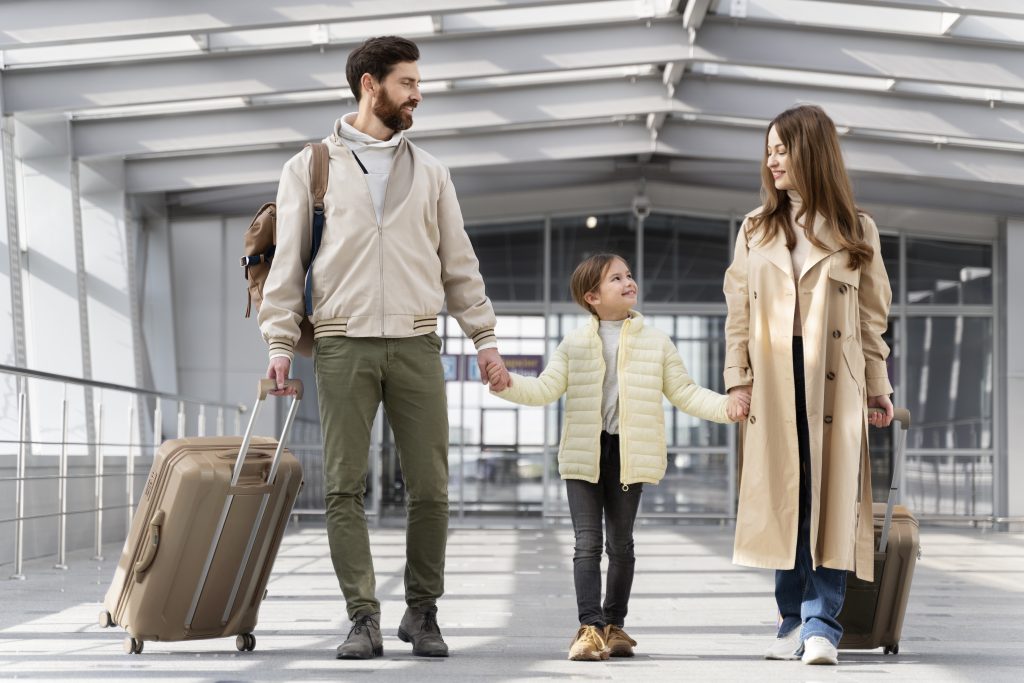
A summer holiday, a school exchange, a medical treatment abroad, a visit to relatives in another country, sooner or later most families face the question of taking a child across the Belarusian border. And almost every parent has heard some version of the same rule: “You cannot leave the country without the other parent’s consent.” In reality, the picture is more nuanced. Belarusian legislation sets out several distinct scenarios, and whether a notarised consent is needed depends on who is accompanying the child, where they are going, and whether any court orders are in place.
This guide explains, in plain English, what the current rules require, how notarised consent is formalised, and what routes are available when the second parent cannot or will not agree to the trip. It draws on the Marriage and Family Code of the Republic of Belarus and on the departure procedure published by the State Border Committee. For readers who need a broader overview of related matters, our family law practice page sets out the wider context.
The Legal Framework in Brief
Two blocks of legislation govern this area. The Marriage and Family Code establishes the principle that both parents have equal rights and equal responsibilities toward their children (Article 76), including the joint determination of the child’s place of residence (Article 74) and the right of the separately-living parent to participate in upbringing (Article 77). Article 76-1 permits parents to record their arrangements, including the procedure for the child’s departure from Belarus, in a notarised Agreement on Children.
The border-crossing procedure itself sits in a separate statute, the Law “On the procedure for exit from and entry to the Republic of Belarus of citizens of the Republic of Belarus.” Together, the two frameworks answer the practical question: who may take a minor across the border and on what documents.
A minor here means any person under the age of eighteen. A valid Belarusian passport is required in every case, a child cannot cross the border on a birth certificate alone, regardless of the travel arrangement.
When the Second Parent’s Consent is NOT Required
The most widespread misconception is that any trip abroad requires a notarised consent from both parents. It does not. The following situations are exempt.
Travel with one parent. If a child is leaving Belarus accompanied by their mother or their father, the written consent of the other parent is not required. The travelling parent presents their own passport, the child’s passport, and, where useful for the destination country, the birth certificate confirming the relationship. This rule applies whether the parents are married, divorced, or have never registered a marriage.
Travel with both parents. No consent from any third party is required, the parents’ joint presence at the border is itself the confirmation of mutual agreement.
Travel by a child permanently residing abroad. Children who live outside Belarus permanently may leave the country accompanied by only one parent, on their Belarusian passport.
Two caveats apply even in these low-friction cases. First, if the accompanying parent is on the list of persons whose right to leave Belarus is temporarily restricted, the trip cannot go ahead until the restriction is lifted. Second, if a court has imposed a travel ban on the child specifically (see below), no combination of documents will let the child through the checkpoint.
When Notarised Consent from Both Parents IS Required
Notarised written consent from both legal representatives is mandatory in two scenarios:
The child is travelling unaccompanied — alone, on a school trip, or with an organised group.
The child is travelling with a third party — grandparents, an aunt or uncle, a family friend, a coach, or any other adult who is not the child’s parent or guardian.
This is the point most families miss when they plan a summer trip with grandma and grandpa. Even close relatives count as third parties for these purposes, and border guards will ask for the notarised consent of both parents, not just one.
How Consent is Formalised
A parent’s consent to a child’s departure is a notarial act. It must be in writing and certified by a person legally empowered to perform notarial actions:
a Belarusian notary;
the territorial Department of Citizenship and Migration of the Ministry of Internal Affairs at the parent’s or child’s place of residence;
in exceptional situations, another official granted this power by law, for example, the chief physician of an inpatient medical institution or the commander of a military unit.
To attend the notary, the parent brings their passport and the child’s birth certificate. If the parent’s passport carries a stamp confirming the child, the birth certificate is not strictly required, though bringing it avoids delays.
The consent document should state the destination country or countries, the period of travel, and, where relevant, the name of the accompanying adult. The current notary fee is 0.5 of the base value, a modest sum that varies from year to year with the base unit.
Consent from a Parent Living Abroad
Life often complicates the timing: the second parent may be working in another country, may have moved abroad after a divorce, or may simply be on holiday when the paperwork is needed. Belarusian law recognises three routes in that situation.
The consent may be certified by a Belarusian consular officer at the embassy or consulate in the country where the parent is located. This is usually the smoothest option because the document is issued in the correct language and format.
Alternatively, the consent may be certified by a foreign notary. In that case, the document has to be apostilled (for countries party to the 1961 Hague Apostille Convention) or consularly legalised (for countries that are not), and then translated into Russian or Belarusian, with the translator’s signature notarised in Belarus. Getting a certified translation right matters, a mistranslated consent will be rejected at the border. Where the paperwork is technical, our notarised translation service handles this end-to-end.
The Hague Conference on Private International Law maintains an up-to-date list of countries that accept the apostille procedure; you can check the current status of any state on the HCCH website.
Family Lawer
Professional legal support for family matters in Belarus — safeguarding rights and family interests!
Sometimes a consent simply cannot be obtained: the other parent has disappeared, has died, has been deprived of parental rights, or refuses to cooperate out of spite. Belarusian law provides a limited but workable set of exceptions.
Statutory exceptions. No consent is needed from a parent who:
has died (a death certificate is presented at the border);
has been declared missing by a court (a certified copy of the decision is presented);
has been declared legally incapacitated;
has been deprived of parental rights;
is a person whose paternity was entered in the birth record only on the mother’s declaration under Article 55 of the Marriage and Family Code, i.e., there is no legally recognised second parent to consent.
Court order authorising departure. Where none of the above applies but the other parent refuses to cooperate, the parent seeking to take the child abroad can apply to the district court at the child’s place of residence for a decision authorising the trip without the second parent’s consent. The court weighs the child’s best interests, the reasonableness of the refusal, the purpose of the trip, and the risk that the child will not be returned. If the application is granted, the court decision itself substitutes for the missing consent at border control.
Agreement on Children. Under Article 76-1 of the Marriage and Family Code, parents can agree in advance on the procedure for the child’s departure abroad and record it in a notarised Agreement on Children. This is a common-sense tool for divorced parents who want to avoid running to the notary before every trip: the agreement can permit routine travel to a defined list of countries without ad-hoc consent. Related matters, such as determining the child’s place of residence, are often addressed in the same document.
Travel Bans on a Child
The opposite scenario also arises: one parent wants to prevent the other from taking the child abroad. A parent may apply to court for a temporary restriction on the child’s departure from Belarus. If granted, the restriction is entered in the database maintained by the Ministry of Internal Affairs, and border guards will refuse to let the child cross the border while the ban is in force, regardless of who is accompanying them.
A travel ban is usually granted where there is a genuine risk that the other parent will take the child abroad and fail to return them. Where a Belarusian court has imposed such a ban and the child has been taken abroad in breach of it, the remedy typically involves proceedings under the 1980 Hague Convention on the Civil Aspects of International Child Abduction. The State Border Committee’s guidance sets out the documents border officers check at the crossing.
If you suspect a ban may be registered against your child, or you want to lift one imposed at the request of the other parent, a full picture of your options is set out on our child travel abroad practice page, and our advocates handle both applying for and challenging travel restrictions.
FAQ
Do I need my ex-spouse’s consent if I take our child on a summer holiday to Turkey?
No. When you personally accompany the child, the other parent’s written consent is not required by the border service. You do need the child’s passport.
We are married, but my husband is on a long business trip abroad. Can our son travel to Poland alone to visit his grandmother?
No, that is unaccompanied travel, so notarised consent from both parents is mandatory. Your husband can certify his consent at the nearest Belarusian consulate, or at a foreign notary with subsequent apostille and notarised translation.
How long is a consent valid for?
The document specifies the travel period itself, anything from a few days to a defined multi-year window. There is no fixed statutory shelf life, but border guards will only honour the period stated in the consent.
The other parent has vanished — no contact for years. What can I do?
Two routes exist. If they truly cannot be located, you may apply to court to have them declared missing, after which no consent is required. Alternatively, you may apply directly for a court decision authorising the child’s departure without their consent.
Can the consent list several countries at once?
Yes. A consent can name a single country, a group of countries (for example, “Schengen area”), or state “any country”, as long as the wording is unambiguous.
Conclusion
The rules on a child’s departure from Belarus are stricter than in many countries, but they are also more predictable than they first appear. Traveling with a parent needs nothing beyond a passport. Travel without a parent needs a properly certified consent from both, or a legally recognised substitute for the missing one. And where the second parent will not cooperate, the courts provide a route that keeps the child’s interests at the centre of the decision.
The single most useful step families can take is to plan ahead: get the consent notarised well before the trip, keep an eye on whether any travel restriction has been registered against the child, and, where the parents live apart, record the travel arrangements in a written Agreement on Children so that each new holiday does not require a new visit to the notary.
About the Author
AMBY Legal Team
AMBY Legal is a team of licensed advocates based in Minsk, Belarus, advising foreign businesses and private clients since 2015.
Child Custody Support
Expert support in Belarus regarding child custody and residence matters with full assistance throughout the process!
Appeal and invalidation of a marriage contract in Belarus are regulated by the Law on Marriage and Family of the Republic of Belarus and other regulatory acts. A marriage contract is a written agreement between the spouses, which regulates their property relations during marriage and in the event of its dissolution. It may contain conditions […]
When a child cannot be raised by their parents — because the parents have died, have lost their parental rights or are unable to care for the child — someone else has to step in, and that person is usually a relative: a grandparent, an aunt or uncle, an adult brother or sister. Most people […]
People making a Belarusian will — or expecting to inherit under one — usually assume the will has the final say: whatever it says goes, and a testator can leave everything to anyone they choose. That is mostly true, but not entirely, and the exception has a name: the obligatory share. Belarusian law reserves a […]
Subscribe for useful materials, key legal updates, and industry trends.
Us on Social Networks
Join us on social media for the latest trends and practical guidance in law and business.
Contact us
Contact us to get information about the project
We use cookies
We use cookies to give you the most relevant experience, remember your preferences, and understand how our site is used. You can accept all cookies, reject non-essential ones, or manage your choices in detail. Read our Privacy Policy and Cookie Policy.
Cookie settings
You can change your preferences at any time. Your choices are stored for 12 months on this device.
Strictly necessary
Always on
On
Essential for core site functionality: authentication, security, load balancing, and remembering your consent. The site cannot work without these cookies.
Cookie name
Provider
Duration
Purpose
cookie_consent
Amby Legal
12 months
Stores your cookie consent preferences.
Functional
Remember your choices such as language, theme, saved form data, and video or audio preferences for a more convenient experience.
Cookie name
Provider
Duration
Purpose
locale
Amby Legal
12 months
Remembers your preferred language.
remember_me
Amby Legal
30 days
Keeps you signed in on trusted devices when you choose to.
Analytics
Help us understand how visitors use the site so we can improve content, navigation, and performance. Includes tools such as Google Analytics, Yandex.Metrica, Hotjar, and Plausible.
Cookie name
Provider
Duration
Purpose
_ga
Google Analytics
2 years
Distinguishes unique users and sessions for usage statistics.
_gid
Google Analytics
24 hours
Distinguishes users within a 24-hour period.
_ym_uid
Yandex.Metrica
1 year
Identifies returning visitors for analytics reports.
_ym_d
Yandex.Metrica
1 year
Stores the date of the user's first site visit.
plausible_ignore
Plausible
Session
Honours opt-out from Plausible analytics when set.